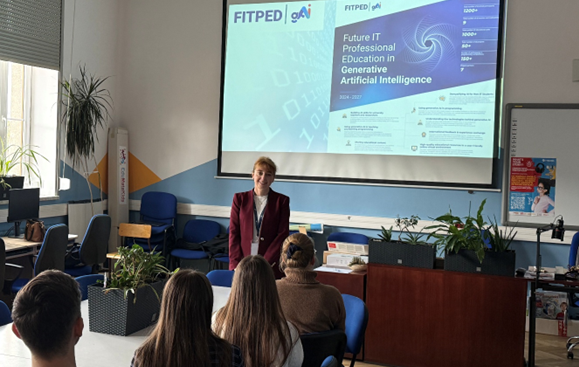
On 16 October 2025, the workshop “FITPED-GAI: Empowering Future Educators with Generative AI” took place at the University of Silesia venue in Cieszyn, as part of DLCC 2025 (Theoretical and Practical Aspects of Distance Learning).
The session was conducted by Małgorzata Przybyła-Kasperek and Kornel Chromiński, and it addressed a question many teacher-education programmes are now facing: how to prepare future teachers for a classroom where generative AI is already part of students’ everyday learning reality.
Generative AI is changing teachers’ work in a very practical way. It can speed up lesson preparation, help create multiple versions of tasks for different ability levels, and support the production of classroom-ready materials – worksheets, prompts, quizzes, rubrics, explanations, and examples. In teacher education, this is not only about “using a tool,” but about developing a workflow that protects quality: defining learning goals first, then using AI as support for drafting and iteration, and finally applying professional judgement to verify accuracy and relevance.
A key benefit for teachers is time and cognitive load. Many daily tasks are repetitive: rephrasing instructions, writing feedback that is clear and constructive, adapting content for learners who need more scaffolding, or preparing alternative explanations. Generative AI can act as a productivity partner in these areas – provided that the teacher remains the decision-maker and treats AI output as a draft, not a final product. This approach is especially helpful for novice teachers, who often struggle with time management and the sheer volume of planning and documentation.
At the same time, generative AI raises new responsibilities that future educators must understand early. AI literacy now includes knowing how to write effective prompts, how to cross-check output, how to spot typical mistakes (hallucinations, oversimplifications, bias), and how to set transparent classroom rules for ethical use. UNESCO has highlighted the need for teacher competencies and guidance around AI in education, including responsible and informed adoption rather than ad-hoc experimentation.
In practice, this means that teacher education has to combine hands-on skill-building with clear discussions about academic integrity, privacy, and fairness.
Within this context, the workshop is naturally aligned with the broader mission of FITPED-GAI, which focuses on developing and sharing open educational approaches and resources that help learners and educators use AI meaningfully across disciplines.
The main message is simple: generative AI does not replace teachers – it changes the profession, and future educators benefit most when they learn how to integrate AI into pedagogy, assessment, and classroom practice with confidence, clarity, and responsibility.